Ojúde Ọba happens every year in Ijebu-Ode, a town about a hundred kilometres from Lagos. Tens of thousands of people attend — some who have been going since childhood, some who flew in from the diaspora specifically for this, some bringing their children to Ijebu-Ode for the very first time.
It is not a religious festival in the way Eid or Christmas is. It is not a harvest celebration or a national holiday. It is a community coming together to pay homage to their king, organised through an age-grade system that is older than the festival itself, conducted in the Yorùbá language from the opening prayers to the last praise song of the day.
This guide covers what Ojúde Ọba is, where it came from, how the day actually runs, and why it matters to diaspora Yorùbá families who may have grown up hearing about it but never had the full picture.
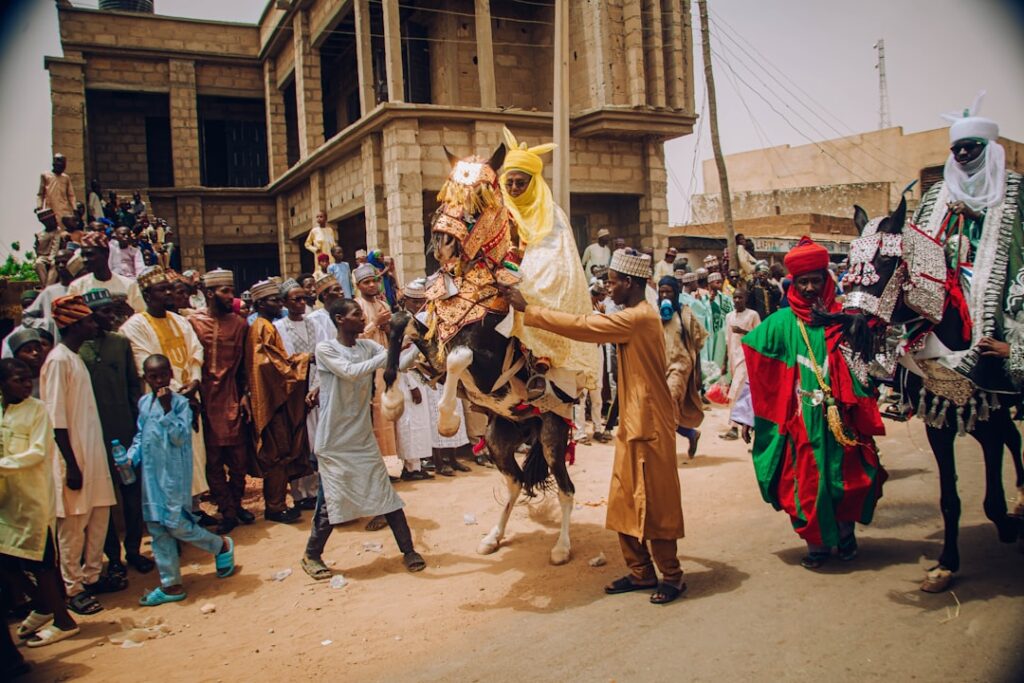
The name has two parts: ojúde means forecourt or the open space just outside the palace, and ọba means king. The King’s Forecourt. It is where subjects gather, and where the king receives them.
In Yorùbá royal tradition, the forecourt is not a waiting room. It is a public space with its own significance — the place where the boundary between the palace and the community becomes a meeting point rather than a wall. Naming the festival after that space says something about what the event is meant to do: bring people together before their king, in public.
The Awujale of Ijebuland — the paramount ruler of the Ijebu Kingdom — is addressed as Kabiyesi, a Yorùbá royal honorific meaning “the one whose authority cannot be questioned.” The homage-paying that sits at the center of Ojúde Ọba is not ceremonial in the casual sense. It is a formal renewal of the relationship between a people and the institution that holds their history.
The festival goes back to the 1890s, but to understand how it started, you have to go back a few decades earlier to when Islam began spreading in Ijebuland.
During the reign of Awujale Afidipotemole in 1878, the Ijebu king allowed Muslim converts to practice their faith freely. This was not common at the time, and the permission triggered a significant wave of conversions. By 1880, mosques had been established in Ijebu-Ode.
One of the most influential converts was Chief Balogun Kuku. He was a wealthy Ijebu man, a former Odeda festival leader, and had more than thirty wives. When Christian missionaries arrived and made monogamy a condition of baptism, conversion was not an option for him. He converted to Islam instead.
This created an immediate problem. Before his conversion, Balogun Kuku had been a central figure in the Odeda festival — the annual celebration where devotees of Yorùbá deities, including Ṣàngó, Ògún, Ọ̀ṣun, and Ẹgúngún, performed and paid homage to the Awujale. Islam discourages that. He could no longer participate as he had before.
Rather than stop participating entirely, he created something new. A ceremony that honored the Awujale and brought the community together, without the elements his new faith prohibited. He called it the Ita-Oba festival. It was later renamed Ojúde Ọba.
What began as a ceremony for Muslim converts expressing gratitude to the king who granted them religious freedom has, over more than a century, grown into something that belongs to the whole Ijebu community — Christians, Muslims, and adherents of the traditional Yorùbá religion attend.
The origins in religious compromise are worth knowing because they explain something about the festival’s character. It was built to find common ground, not to enforce uniformity.
The Regberegbe are age-grade associations — organized groups of people born in the same rough period who share social responsibilities and community obligations throughout their lives. The system is much older than Ojúde Ọba and has historically been part of how Ijebu society has organized labor, governance, and communal participation.
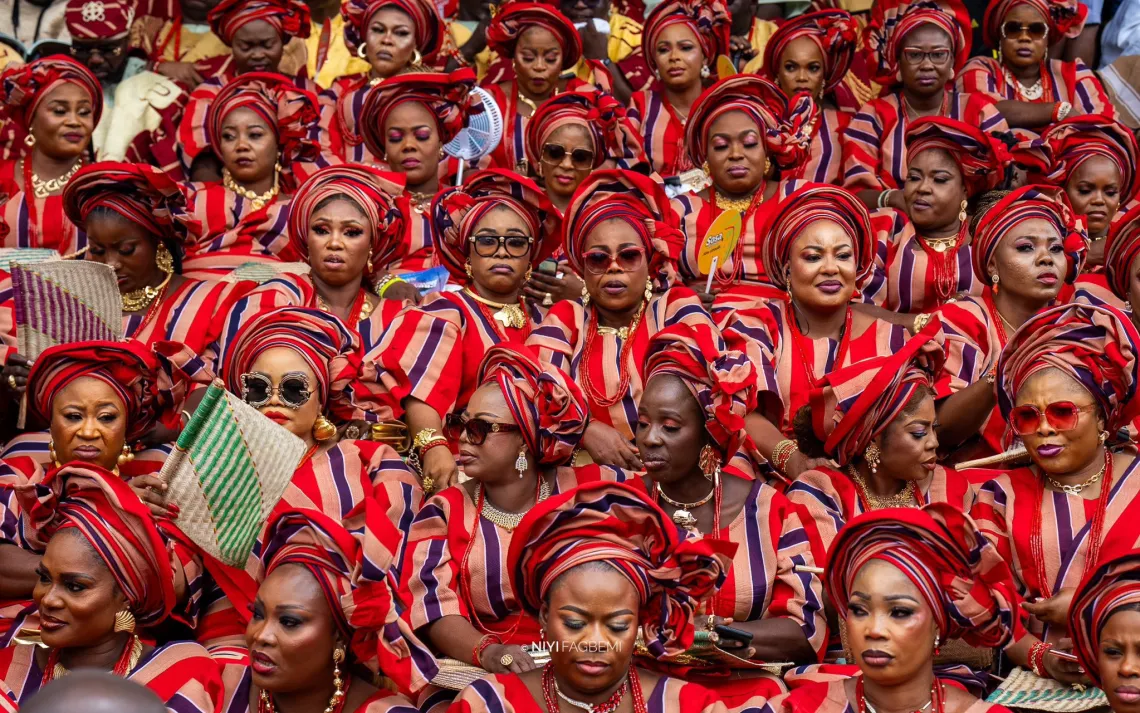
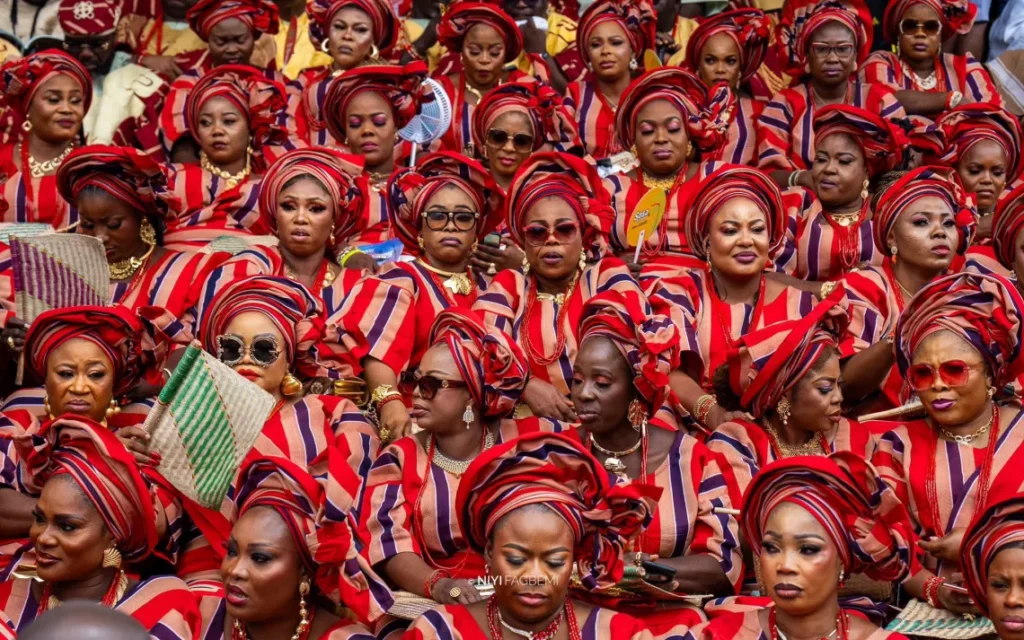
At the festival, each Regberegbe marches as a unit. Every member of the group wears the same fabric, the same colors, coordinated headwear. Some groups plan their looks months in advance. Fashion influencer Farooq Oreagba, known as Mr. Steeze, who has become one of the festival’s most recognizable attendees, calls Ojúde Ọba a “leveler” — a place where members of the same age cohort show up in the same clothes regardless of wealth or status.
That quality is one of the more unusual things about the festival. Nigerian social life has fairly visible hierarchies. Ojúde Ọba, through the Regberegbe structure, enforces a temporary equality within cohorts that overrides the usual signals. A retired general and a market trader born in the same year march together. The age-grade is the identity for the day.
Each Regberegbe carries a name, a history, and a collective character that its members build over decades. The groups also delegate representatives to pay formal homage to the Awujale on the day — the homage is paid by the group, not by an individual.
The festival is a single full day. It has a program that has accumulated structure over more than a century, and most of it happens in a specific order.
The day starts with prayers led by the Chief Imam of Ijebuland — a direct acknowledgment of the festival’s Islamic origins. After prayers, three anthems are sung in sequence: the Nigerian National Anthem, the Ogun State Anthem, and the Awujale Anthem. The sequence moves from the national to the regional to the specifically local, and it takes a few minutes for the full weight of that to land.
Then the Oriki Ijebu. The recitation of ancestral lineage praise in Yorùbá that traces the history and achievements of the Ijebu people back to their founding. Oriki are not summaries. They are performed praise-poetry — specific, named, full of references that mean something to the people in the room and nothing to someone who does not know the language or the lineage. Hearing your family’s oriki recited in public is, by many accounts, one of the more unexpectedly moving experiences the festival offers.
The Balogun chiefs — descendants of pre-colonial-era Ijebu military commanders — arrive on horseback in ceremonial dress. Drums play. Praise singers call out their lineages. The Balogun class historically led the Ijebu military, and this procession carries that into the present in a way that is more than symbolic. The horses are real. The riders know who they are descending from. The drums are not decorative.
Each age-grade group processes in turn. This is when the fashion becomes most visible — aso-oke, lace, damask, elaborate gele, carefully shaped fila. Some groups have clearly spent months coordinating. Others keep it simpler. The variation between groups is part of what makes the processions worth watching; each Regberegbe has its own character, and the dress choices often reflect that.
Each Regberegbe delegation presents its tribute at the palace forecourt and acknowledges the Awujale. This is what the festival is named for. The processions, the oriki, and the music all build toward this act — the community renewing its acknowledgment of the institution that holds it together. After 130-plus years of it, the repetition has not worn it down. It has made it heavier.
In July 2025, Oba Sikiru Kayode Adetona died at the age of 91. He had been the Awujale of Ijebuland since 1960 — 65 years on the throne. Under his reign, Ojúde Ọba grew from a significant local gathering into a festival that draws international visitors and appears in global media coverage.
The succession process has not gone smoothly. The Awujale stool rotates between four ruling houses, and the Ogun State Government halted the process twice — in December 2025 and again in January 2026 — citing procedural concerns. As of now, no new Awujale has been confirmed.
Ojúde Ọba is built around the act of paying homage to the king. What that looks like when the throne is vacant is a question the Ijebu community is navigating in real time. But the festival has survived more than a century of disruption — religious transition, colonial intrusion, and political turmoil. The Regberegbe will coordinate. The oriki will be recited. The homage will be directed wherever it needs to go. The ceremony has its own momentum now.
For Ijebu families abroad, Ojúde Ọba is one of those events that turns a visit to Nigeria from a family trip into something harder to explain. Many people plan their annual trips around the festival. Some bring children who have never been to Ijebu-Ode before, who will attend, watch, and maybe understand a third of what is happening.
That last part is the honest problem. Almost everything that happens at Ojúde Ọba is conducted in Yorùbá. The oriki are in Yorùbá. The ancestral recitations are in Yorùbá. Greetings among Regberegbe members are in Yorùbá. The Awujale Anthem is in Yorùbá. A child who grew up in Birmingham or Toronto with limited Yorùbá will see the horses, the fashion, the processions. They will miss most of what is being said — and at a festival built on lineage, the words are where most of the meaning lives.
Even for Yorùbá families who are not Ijebu — Ọ̀yọ́, Lagos, Ẹ̀gbá, Ọ̀ṣun — the festival is a useful reminder that Yorùbá culture is not one thing. It is a family of subgroups, each with its own festivals, its own praise traditions, its own relationship to the monarchy. Ojúde Ọba is one of the clearest expressions of what Ijebu culture specifically looks like, and understanding it requires the language that runs through it.
Ojúde Ọba is held on the third day after Eid al-Kabir (Eid al-Adha), known in Yorùbá as Ileya. Because the Islamic calendar is lunar, the date shifts every year relative to the Gregorian calendar, typically falling between May and July. You’ll need to check the current Islamic calendar for the exact date each year.
In Ijebu-Ode, Ogun State, southwestern Nigeria. The main events take place at the Awujale’s palace forecourt and a large public stadium. Ijebu-Ode is roughly 100 kilometers northeast of Lagos.
Age-grade associations — groups of people born in the same rough period who are organized as a social unit throughout their lives. Each group has a name and a collective identity. At Ojúde Ọba, they process in coordinated dress and present homage to the Awujale as a unit. They are the organizational backbone of the festival.
No. It began as a Muslim gathering in the 1890s, but it has been open to all faiths for generations. The festival today is attended by people of every religion and none. The Chief Imam leads the opening prayers, but the rest of the day is cultural, not religious.
The Awujale is the paramount ruler of the Ijebu Kingdom. The most recent Awujale, Oba Sikiru Kayode Adetona, reigned from 1960 until his death in July 2025. He was 91 years old and had held the throne for 65 years. The succession process is currently ongoing — the Awujale stool has been vacant since his passing, and as of early 2026, no successor has been confirmed.
Yes. Non-Ijebu Nigerians, diaspora visitors, and international tourists attend every year. The Regberegbe processions and homage-paying are Ijebu traditions, but the festival is not closed. It is increasingly well-known beyond Ijebuland, and the community welcomes people who come to observe respectfully.
| Ojúde Ọba is conducted in Yorùbá. If you want to be present in the full sense of the word, the language is where that starts. Explore our programmes at Alámọ̀já Yorùbá. Start with the Yorùbá Beginners School if you’re starting from zero, the Yorùbá Club for Kids for your children, or Personalised Classes if you’d prefer to work at your own pace. |
Share Post On:
Get the latest Yoruba learning resources delivered to your inbox