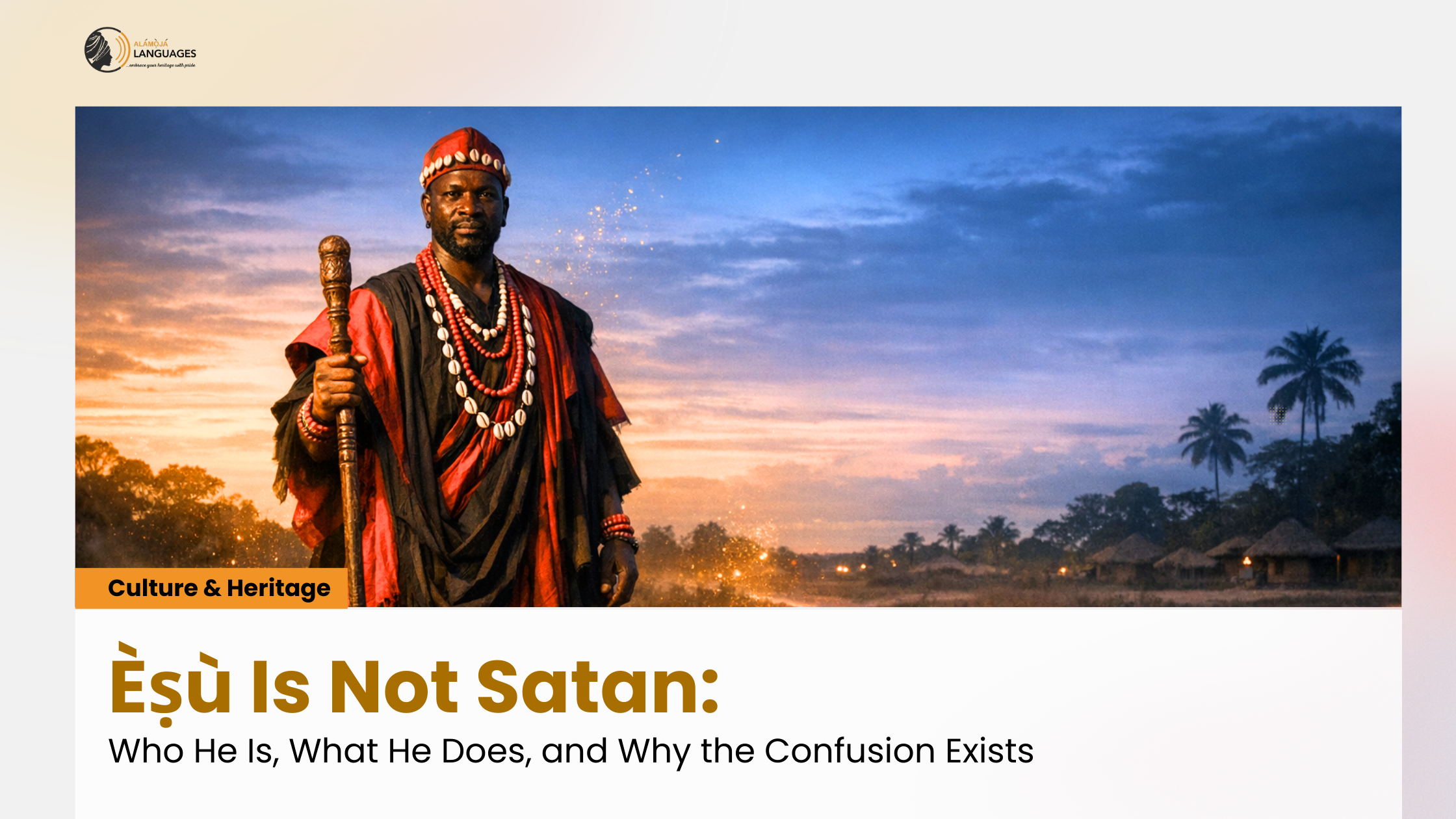
Èṣù is a primordial Yoruba deity. The divine messenger, enforcer of cosmic law, and guardian of the crossroads. He is not Satan. The confusion between the two traces directly to a deliberate mistranslation in the 1860 Yorùbá Bible, where Bishop Samuel Ajayi Crowther used “Èṣù” as the Yorùbá word for “devil.” These are two cosmologically distinct beings. One serves Olodumare; the other opposes God. They share nothing beyond a colonial misreading that has lasted over 160 years.
There is a conversation happening across Yorùbá communities worldwide — in Lagos, in London, in Lagos again on Instagram — about a name. A name that was stolen, corrupted, and handed back soaked in someone else’s theology.
That is the name is Èṣù. For decades, Yorùbá Christians have used it to mean the embodiment of evil itself. Children have grown up hearing “Èṣù” and feeling fear, not reverence. Mothers have invoked it as a curse. Preachers have used it to delegitimize an entire ancestral spiritual tradition.
All of it rests on a mistranslation made in 1860.
This article does two things: it tells you who Èṣù actually is, and it explains exactly how and why the confusion was created and what it has cost.
To understand Èṣù, you have to first understand Yorùbá cosmology on its own terms, not through a Christian, Western, or colonial lens.
In the Yorùbá worldview, Olodumare is the supreme being, the ultimate source of all existence. Beneath Olódùmarè are the Òrìṣà. The Òrìṣà are regarded to be primordial divinities who each govern specific aspects of the cosmos and human life. Sàngó governs thunder. Ògún governs iron and war. Ọ̀sun governs rivers, fertility, and love. These are not demons. They are cosmic forces, assigned roles within a deeply ordered universe.
Èṣù, one of these cosmic beings holds one of the most important roles in that universe. Some of which includes;
Being the Messenger Between Worlds
Èṣù is the intermediary between all realms — between humans and the Orisha, between the living and the ancestors, between earth and Ìkọ̀lé Ọ̀run (the spiritual realm). No prayer, sacrifice, or offering reaches its destination without passing through Èṣù. He is, in effect, the communication infrastructure of the cosmos.
This is why he is always the first to be acknowledged in any Yorùbá spiritual gathering. To ignore Èṣù is to send a message with no carrier. The prayer goes nowhere.
In many African diasporic traditions — Candomblé in Brazil, Haitian Vodou, Santería in Cuba — this same figure is known as Exu, Legba, or Papa Legba. The names differ across the Atlantic. The function remains the same: the one who opens the road.
Èṣù is the deity of crossroads, thresholds, and transitions. The spaces between what was and what could be. Crossroads in Yorùbá cosmology are not dark or ominous. They are points of potential, decision, and movement. Wherever paths diverge, Èṣù is present.
He is known as onílé-oríta (the one who builds his house at the road junction). He protects travelers. He governs opportunity and fortune. He presides over markets, gateways, and doorways — the liminal spaces where life shifts direction.
Perhaps most importantly, Èṣù is the chief enforcer of cosmic law. He does not create chaos — he regulates the boundary between order and disorder. He ensures that the laws of Olódùmarè are upheld and that the consequences of human actions are properly delivered.
Scholars of Yorùbá religion have described Èṣù as the “Inspector General” of the cosmos — one who reports the deeds of both divinities and humans directly to Olodumare. He does not take sides. He is a neutral force. He carries good tidings when good has been done. He carries consequence when the law has been broken.
He is also a master of languages — every tongue spoken on earth — and a teacher who sometimes uses difficulty and irony to lead people toward growth. His lessons are not comfortable, but they are not malicious. There is a difference between a strict teacher and an enemy.
Satan, in Abrahamic theology, is a figure defined entirely by opposition to God. He fell from grace through pride and has since devoted his existence to deceiving humanity, corrupting God’s creation, and working against divine will at every turn. He is not neutral. He has an agenda — and that agenda is destruction.
Èṣù is none of those things.
Èṣù does not oppose Olodumare. He serves Olódùmarè. He does not deceive humans for sport or malice. He delivers the consequences of their own choices. He does not seek dominion over souls. He enforces the laws that govern them.
As one traditionalist described it: Èṣù is the Yorùbá deity that maintains law and order in the cosmic realm. We call Èṣù the police. Satan is the criminal.
| Attribute | Èṣù (Yorùbá Deity) | Satan (Abrahamic Theology) |
| Relationship to the Supreme Being | Serves and reports to Olodumare | Opposes God; cast out of heaven |
| Primary role | Messenger, cosmic intermediary | Deceiver and adversary of humanity |
| Moral position | Neutral enforcer of cosmic law | Purely malevolent |
| Attitude toward humans | Protector when propitiated; consequential when ignored | Predatory; seeks to destroy |
| Purpose in the cosmos | Maintains order and balance | Sows disorder and corruption |
| Nature of trickery | Pedagogical — teaches through paradox and irony | Manipulative — aimed at damnation |
| Relationship with other divinities | Collaborates with all Orisha | Adversary to all divine order |
These are not two versions of the same being. They are cosmologically incompatible.
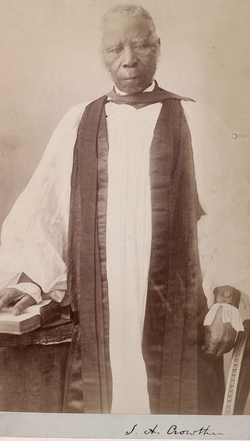
In 1860, Bishop Samuel Ajayi Crowther — a Yorùbá man who had been enslaved as a child, liberated by the British, educated in England, ordained as the first African Anglican bishop — was commissioned by the Church Missionary Society to translate the Bible into Yoruba.
This was a remarkable intellectual achievement. Crowther standardized a written form of Yorùbá, compiled the language’s first dictionary, and completed the full Bible translation. His linguistic work was extraordinary.
But in that translation, every occurrence of the word “devil” — all thirty-five of them in the New King James Version — was rendered as Èṣù.
Consider what that means. The sentence in Revelation 20:10 — “And the devil that deceived them was cast into the lake of fire” — became, in Yorùbá: A sì wọ́ Èṣù tí ó tàn wọ́n jẹ lọ sínú adágún iná àti súfúrù. Èṣù, cosmic messenger and enforcer of divine law, written into the fires of damnation.
And yet, Crowther did not translate “Satan” as Èṣù. He used “Sàtánì” — a Yorubanized version of the English word. He had another option for the word “devil” too. He chose not to use it.
This choice was not an innocent linguistic accident. It happened inside a specific context: British colonialism, the Church Missionary Society’s mandate to convert and “civilize” Africa, and a newly Christian convert’s complicated relationship with his own ancestral tradition.
Crowther had described Yorùbá land as “a land of heathenism, superstition, and vice.” His Christianity had been shaped entirely by colonial British evangelism, an ideology that treated African spiritual traditions not as different but as inferior — worse, as demonic.
The theological logic at work was this: if you want people to abandon their ancestral religion, you don’t argue against it. You demonize its central figures. You take the deity they have trusted for generations and make him synonymous with the source of all evil. Conversion becomes not just a spiritual choice but a moral necessity.
The Yorùbá pantheon of gods was demonized. Meanwhile — as scholars have pointedly noted — Greek gods like Zeus and Apollo were being romanticized by European philosophers and poets. The double standard was not incidental. It was structural.
One of the most damning pieces of evidence is the question scholars have raised: if Èṣù could be translated as Satan because of perceived similarities, why was Jesus not translated as Ọ̀rúnmìlà?
Ọ̀rúnmìlà in Yorùbá cosmology is wise, calm, peaceful, and forbearing — a closer cultural parallel to the Jesus of the Gospels than almost any other figure. The translators did not make that equivalence. They Yorubanized “Jesus” as “Jesu Kristi.”
The asymmetry is the answer. Cultural equivalence was only permitted when it served delegitimization.
The consequences of this single translation choice have been generational.
In contemporary Yorùbá, to call someone Ọmọ Èṣù (child of Èṣù) is to call them a child of the devil. A deity that was once worshipped, propitiated, and respected as a cosmic force of order has become a household synonym for evil.
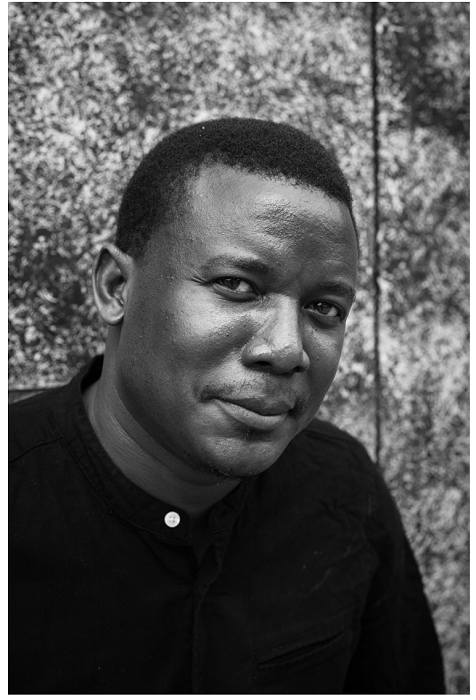
Practitioners of Isese, the Yorùbá traditional religion have faced discrimination, social ostracism, and violence, their spirituality dismissed as Satanic because the figure central to their practice was branded as such. Dictionaries published as recently as 2003 retained Èṣù’s definition as “devil.” Google Translate carried the same definition for years until Nigerian linguist and writer Kola Tubosun, working at Google, corrected it in 2016 and again in 2019 when the changes were reversed. The translation now reads simply: “Èṣù.”
This is what happens when language is used as a tool of cosmological imperialism. The damage outlives the colonizer.
Curious about the Yorùbá language and culture? Join one of our structured classes and begin your journey to fluency today.
The resistance has been building for years.
In 2014, a group of Yorùbá traditionalists designated December 24 as a day for public education on Yoruba religion and culture, specifically to address the misrepresentation of Èṣù. From this grew the #EṣùIsNotSatan campaign; a grassroots, cross-platform movement demanding a correction of the colonial record.
The campaign has drawn Ifa priests, scholars, activists, and diaspora communities across Africa, Brazil, Cuba, the United States, and the United Kingdom. Annual “Walk for Esu” festivals have been held in cities like Ibadan. Academic papers have been published. Documentaries have been made.
The argument is not that Christianity is wrong. It is that a Yorùbá deity was borrowed without consent to play a theological role in someone else’s religion and that borrowing has cost an entire spiritual tradition its dignity.
Èṣù does not need to be rehabilitated. He was never guilty of what he was accused of. He needs to be returned to what he has always been.
No. Èṣù is a morally neutral cosmic force. He enforces the laws of Olódùmarè without bias — rewarding those who fulfill their obligations and delivering consequences to those who do not. His reputation for “trickery” comes from his pedagogical nature: he uses irony, paradox, and difficulty to push humans toward wisdom. That is not evil. That is education.
Èṣù has trickster qualities, but “trickster” is an incomplete label that Western scholarship has leaned on too heavily. Yes, he uses confusion and paradox — the famous story of his two-coloured hat, red on one side and black on the other, causing villagers to argue over what colour it was, illustrates his teaching method. He reveals how perspective shapes perception. That is not mischief for its own sake. It is philosophy in action.
Because Crowther’s 1860 Bible translation formed the foundation of Yorùbá Christianity. Subsequent dictionaries, preachers, and cultural norms built on that foundation without questioning it. The error was reproduced across generations, absorbed into everyday Yorùbá language, and became so embedded that questioning it now feels, to many, like questioning Christianity itself. That is precisely why the correction matters.
Èṣù is associated with the colours red and black, the number three, crossroads, and the threshold of the home. Shrines dedicated to him are often adorned with cowrie shells, money, and offerings of food and tobacco. He is represented with two faces — symbolizing duality, watchfulness, and the balance between opposing forces. He is the first Orisha acknowledged in any ritual gathering, reflecting his role as the one who opens all channels of communication.
These are all the same cosmic figure, known by different names in different parts of the African diaspora. Elegba (also Elegbara) is used in Nigeria and Cuba. Exu is used in Brazilian Candomblé. Papa Legba is used in Haitian Vodou. The Trans-Atlantic slave trade scattered Yorùbá people across the Americas, and the deity’s name and aspects evolved regionally — but the core function as divine messenger and guardian of the crossroads remains consistent.
In contemporary Yorùbá usage, Ọmọ Èṣù means “child of the devil” — and yes, it is used as an insult. This usage is a direct product of the colonial mistranslation. In its original cosmological context, being a devotee of Èṣù carried status and meaning: it meant you were aligned with the divine force that opens roads, delivers prayers, and enforces cosmic order. The insult is borrowed theology, not Yorùbá tradition.
Èṣù is one of the most significant primordial divinities in Yorùbá cosmology — a cosmic messenger, guardian of crossroads, enforcer of divine law, and intermediary between all realms of existence.
He is not Satan. The association was constructed in 1860 by Bishop Samuel Ajayi Crowther, a formerly enslaved Yorùbá man whose Christianity had been shaped entirely by British colonial evangelism. When Crowther translated the Bible into Yoruba, he used “Èṣù” for every occurrence of “devil” — a choice that demonized a revered deity and destabilized an entire spiritual tradition.
The differences between Èṣù and Satan are not subtle. They are fundamental. One serves the supreme being; the other opposes him. One enforces cosmic law; the other corrupts it. One opens roads for human flourishing; the other seeks to destroy it.
The #EṣùIsNotSatan movement is not anti-Christian. It is pro-accuracy — a demand that a Yorùbá deity not be conscripted into a theological war he has nothing to do with.
Èṣù is Èṣù. He always has been.
Share Post On:
Get the latest Yoruba learning resources delivered to your inbox