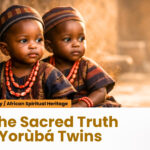
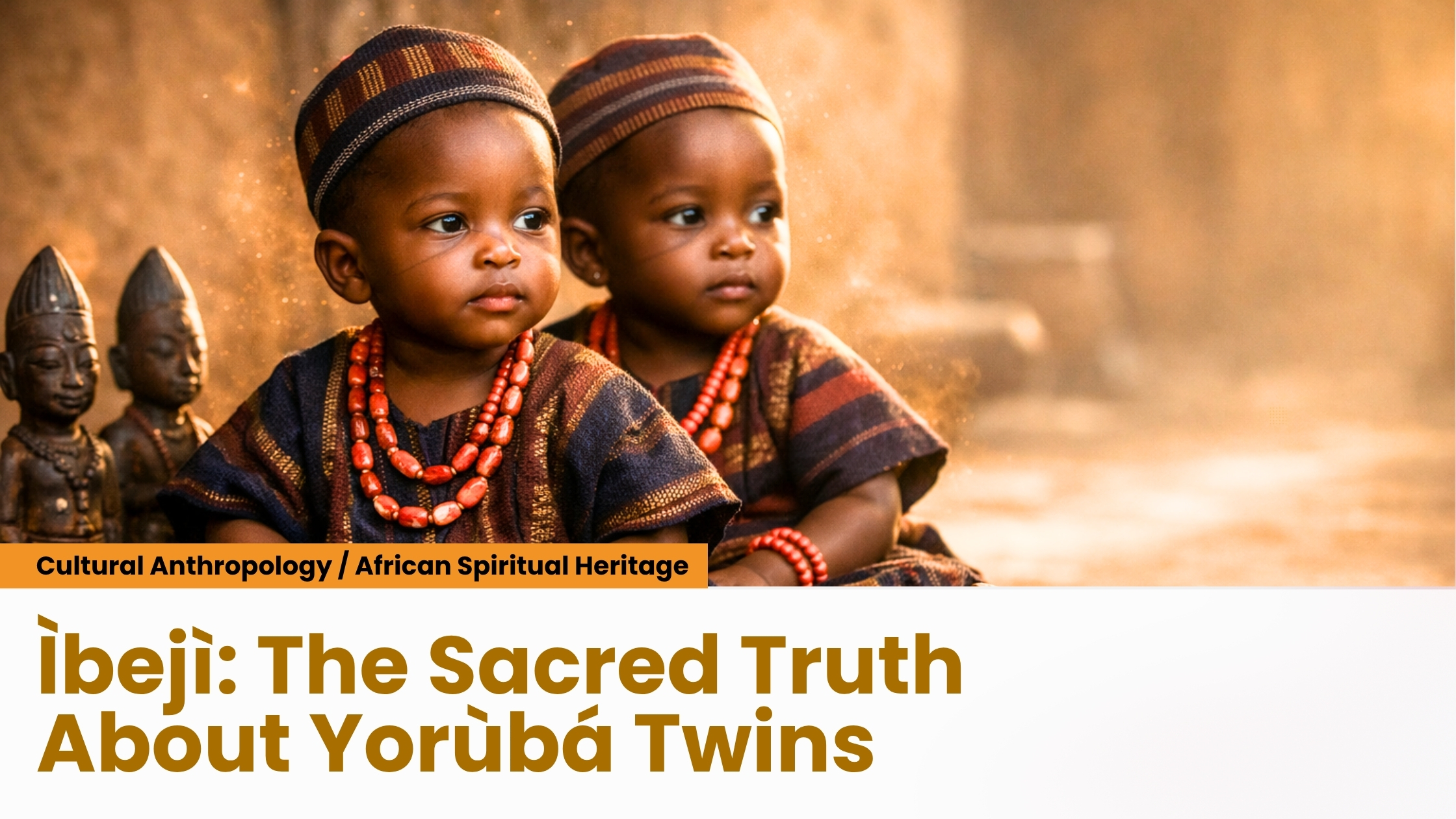
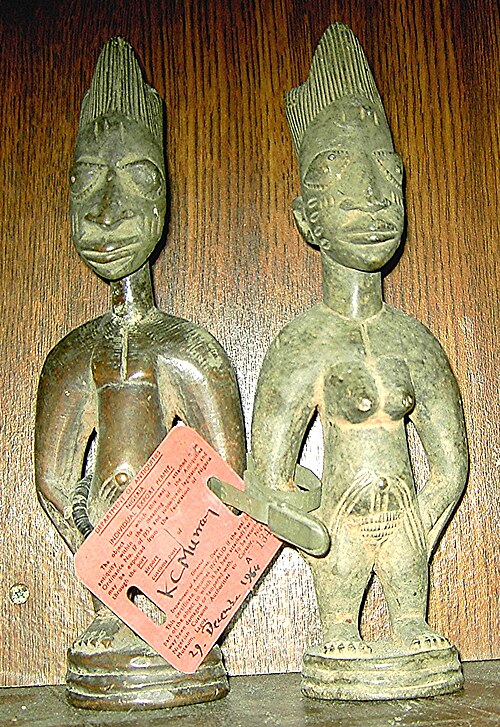
Yorùbá twins, known as Ìbejì or Èjìrẹ́, hold a sacred place in Yorùbá culture. They are believed to be divine gifts from Olódùmarè, the supreme being, carrying extraordinary spiritual power. The firstborn, Táíwò, is considered the younger twin despite being born first. The secondborn, Kẹ́hìndé, is the elder. When a twin dies, families commission a carved wooden figure called Ère Ìbejì to house the departed spirit.
Across much of the world, twin births are ordinary biology. Among the Yorùbá people of southwestern Nigeria, Benin Republic, and Togo, they are something else entirely: a spiritual event, a household transformation, and a direct link to the divine.
To understand Yorùbá twins is to understand something fundamental about how Yorùbá culture reads the world. Birth order, seniority, fate, and family identity all bend around the presence of Ìbejì. The names given before birth, the foods cooked in their honour, the carved wooden figures kept for those who die too young, none of this is superstition dressed up as tradition. It is a coherent, layered belief system that has survived centuries of contact with Islam, Christianity, colonialism, and diaspora.
This article covers all of it.
The word Ìbejì breaks down into two Yorùbá roots: ibi (birth) and eji (two). Translated directly, it means “double birth,” or more poetically, “born twice.” In recent usage, particularly in diaspora communities, the phrase is also taken to mean “double blessings.”
There is a second Yorùbá word used interchangeably for twins: Èjìrẹ́, which carries the meaning of “two who rhyme” or “two persons who are the same.” The phrase captures something about the uncanny nature of twins, how they appear as a single person split into two bodies, a repetition that feels intentional rather than accidental.
You will also hear the term Edúnjobí and Ejire Okin in different communities and praise contexts. These are regional and poetic variations, but they all point to the same cultural understanding: twins are not ordinary children.
The existence of multiple names for twins in Yorùbá is itself telling. A concept that generates this much vocabulary is a concept that a culture has thought about deeply.
When Yorùbá parents call their twins Ìbejì, they are not just naming them. They are invoking a class of beings with defined spiritual characteristics, known powers, and specific ritual obligations.
In the Yorùbá religious system, twins are not simply blessed children. They are earthly representations of a specific Òrìṣà: the Òrìṣà Ìbejì. Unlike Òrìṣà, who governs thunder or iron or rivers, Ìbejì governs something less visible but just as powerful: the spiritual balance between two mirrored forces.
The Òrìṣà Ìbejì is associated with youth, vitality, joy, and abundance. They are also believed to carry the powers of fertility, prosperity, and healing. A household that honours its Ìbejì correctly can expect blessings to flow. A household that neglects them risks the opposite.
This is not a minor deity relegated to the fringes of the pantheon. The Ìbejì Òrìṣà holds a recognised place among the Yorùbá gods, invoked in Ifá divination and worshipped through specific rituals tied to the welfare of twin children.
Two major Òrìṣà are closely tied to the protection of Yorùbá twins.
Sango, the god of thunder and lightning, is believed to be the principal protector of twins. His association with power, sudden force, and fire makes him the guardian against any spiritual harm that might threaten them. The colours and beads used to decorate Ère Ìbejì figures often reference Sango.
Yemoja, the goddess of water and motherhood, appears in a central myth about the origin of the Ìbejì belief. According to one widely-told narrative, Yemoja herself gave birth to twins and lost one. Her grief and her refusal to abandon the spirit of the departed child became the origin of the Ère Ìbejì practice — carving a wooden figure to house the soul of a twin who has died. In this story, the ritual is not just cultural custom. It is an act of motherhood taught by a goddess.
When Yorùbá parents care for an Ère Ìbejì figure, they are following Yemoja’s example.
This is the detail that surprises almost everyone who encounters the Yorùbá twin culture for the first time.
The firstborn twin is called Táíwò (also spelled Taiwo, Taiye, or Taye), a shortened form of the phrase To-aiye-wo, meaning “the one who tastes the world.” Táíwò arrives first, sees the world first, breathes first. By every visible measure, Táíwò is the elder.
Except, according to Yorùbá belief, Táíwò is not the elder. Táíwò is the younger.
The secondborn twin is called Kẹ́hìndé (also spelled Kehinde or Kenny), from the phrase Omo kehin dé, meaning “the child who comes last has arrived.” Kẹ́hìndé is the elder in spirit and in status, even though the world sees them emerge from the womb second.
To understand this, you need to understand the Yorùbá concept of Egbe, the spiritual world of the unborn. In Yorùbá belief, every person exists in Egbe before they come to earth. Relationships are formed there. Spiritual personalities are established there. The decision to be born is not an accident — it is a departure from a world that already knew you.
In the case of twins, both souls existed in Egbe together. Kẹ́hìndé, the more senior of the two, sent Táíwò ahead to taste the world and report back. Was it safe? Was it beautiful? Was it worth entering? Táíwò, adventurous and curious by nature, went first.
Once Táíwò had given a signal (some say by crying), Kẹ́hìndé followed — careful, deliberate, already knowing what to expect because Táíwò had scouted the path.
This myth is not decoration. It shapes how parents understand their twins’ personalities. Táíwò is expected to be curious, restless, and nonchalant. Kẹ́hìndé is expected to be reflective, strategic, and more observant. Parents use this framework to guide how they raise each child, what occupations they might be suited for, and how they navigate sibling dynamics.
The reversal of birth order seniority is one of the most culturally distinctive features of the Yorùbá twin belief system. It does not map onto any other Nigerian ethnic group’s tradition in the same way, and it comes entirely from this spiritual logic.
Food is central to how Yorùbá families honour their twins. Two dishes appear consistently across twin-related rituals.
Ẹ̀wà Ìbejì (beans for twins) is a bean dish cooked specifically in honour of Ìbejì. It is believed to bring blessings, good health, and spiritual protection to the twins and the household. Families cook and share it during ritual celebrations or at intervals prescribed through Ifá consultation.
Ekuru is another bean-based dish (described as white Moi Moi) prepared with a palm-oil stew. It is commonly offered during specific twin rituals, particularly those focused on health or protection. Mothers of twins still cook it regularly, decades after their children have grown.
The consistency of beans in Ìbejì ritual food is notable. In Yorùbá cosmology, beans carry connotations of fertility and spiritual protection, making them appropriate offerings for beings who arrive trailing divine favour.
In Yorùbá, the titles given to parents of twins carry weight beyond the literal.
Ìyá Ìbejì means “Mother of Twins.” But in practical usage, it does not just mean a woman who gave birth to two children at once. It means the mother of good fortune, the mother of prosperity, the one most specially chosen by the divine. The title commands respect in the community. It comes with ritual obligations — specific occupations, specific foods, specific interactions with the Òrìṣà Ìbejì shrine.
Bàbá Ìbejì, “Father of Twins,” carries similar weight. Historically, the community would consult a Babalawo on the third day after the birth of twins to understand what occupations and responsibilities the parents were now expected to carry. Commonly prescribed occupations included trading in palm oil, beans, or cloth, or going out to request alms from the community. These are not arbitrary. They reflect the nature and preference of the Ìbejì themselves, communicated through the oracle.
The birth of twins in a Yorùbá family changes the naming rules for everyone who comes after them. The children born after twins receive their own pre-ordained names:
| Birth Position | Name (Male) | Name (Female) | Meaning |
| First after twins | Ìdòwú | Ìdòwú | First child born after Ìbejì |
| Second after twins | Ìdogbé | Àlàbá | Second child after Ìbejì |
| Third after twins | Àpàrà | Àpàrà | Third child after Ìbejì |
These names are part of the Orúko Àmútọ̀runwá system — names brought from the spirit world, assigned not by parents but by spiritual circumstance. A child named Ìdòwú carries that identity whether or not the family understands its significance. The Yorùbá naming system acknowledges that birth order in a family with twins is not ordinary.
The reverence for Yorùbá twins was not always there. Research published in academic journals on Yorùbá customs notes that earlier Yorùbá communities considered the birth of twins an omen. The reasoning in those communities was that twins were not fully human — they belonged more to the spirit world than to the living world. Drastic responses were recorded, including infanticide and the banishment of twin-bearing mothers from their communities.
What shifted the culture was the gradual absorption of the Ìbejì Òrìṣà into the mainstream Yorùbá religious pantheon. As twins came to be understood not as threats but as bearers of divine favour, the practices around them transformed from fear-management to celebration. The ritual care of Ère Ìbejì figures replaced the earlier fear-driven responses. Twins became royalty among children, not cautionary figures.
This historical arc matters because it shows that tradition is not static. What the Yorùbá now celebrate as one of their most distinctive cultural gifts went through centuries of negotiation. The reverence for Ìbejì is not a custom that arrived fully formed. It was built.
Any article about Yorùbá twins often times point at Igbo-Ora. Igbo-ora, a town located in Oyo State about 80 kilometres north of Lagos, holds an extraordinary distinction: it has one of the highest twin birth rates ever recorded anywhere on earth. The global average for twin births is approximately 12 per 1,000 births. In Igbo-Ora, studies have reported rates ranging from 45 to 53 twin births per 1,000 deliveries, with some earlier figures reaching higher levels.
| Location | Twin Births per 1,000 Deliveries |
| Global average | ~12 |
| Europe average | ~16 |
| United States | ~33 |
| Southwest Nigeria (Yorùbá region) | ~45–50 |
| Igbo-Ora, Oyo State | 45–68 (studies vary) |
Source: PMC / National Center for Biotechnology Information; Al Jazeera; AlphaBiolabs
The town has embraced this identity. A stone plinth at its entrance declares it the “Twin Capital of the World.” An annual World Twins Festival, launched in 2018 by a pair of twin brothers, draws twin families from across Nigeria and the diaspora. At a 2024 edition, a visiting Yorùbá king noted that “there’s hardly a family here in Igbo-Ora that doesn’t have a twin.”
Why so many twins? Researchers have proposed two main theories.
The genetic hypothesis points to hereditary factors amplified by endogamy (the Igbo-Ora community historically marrying within itself), which may have concentrated twin-related genes over generations. Most twins born in Igbo-Ora are dizygotic (fraternal), meaning they result from two separately fertilised eggs. This type of twinning is inheritable through the mother’s side.
The dietary hypothesis points to ilasa, a local soup made from okra leaves boiled with salt, spices, locust beans, and melon seeds. Research from the University of Lagos Teaching Hospital identified a chemical found in the peelings of yam and cassava tubers — also consumed heavily in this region — that may stimulate the release of more than one egg per cycle. However, researchers caution that no direct causal link has been confirmed.
What is clear is that Igbo-Ora’s relationship with twins goes beyond biology. The town does not just produce twins at high rates. It celebrates them, names them, feeds them, and builds festivals around them. The culture and the biology have grown up together.
Across the United Kingdom, the United States, Canada, and wherever Yorùbá communities have settled, the Ìbejì tradition has travelled with them.
You will find Táíwòs and Kẹ́hìndés in classrooms in London, Houston, Toronto, and Lagos who were named before their parents knew their gender, because in Yorùbá custom, the names are fixed regardless. You will find Ìyá Ìbejì preparing Ẹ̀wà Ìbejì in a kitchen in Birmingham or Brooklyn, maintaining a ritual that their own mothers and grandmothers maintained before them.
Some families practise the full traditional system. Others hold the names and the food while setting aside the Òrìṣà elements. Many simply carry the cultural pride of being part of a tradition that treats twin birth as the highest form of blessing.
What the diaspora context adds is visibility. Non-Yorùbá partners and friends encounter Táíwò and Kẹ́hìndé and ask why the secondborn is called the elder. Understanding Ìbejì is not just about understanding a belief system. It is about understanding how the Yorùbá read identity, family, spirit, and the cosmos. The twins are a window into it all.
Ìbejì comes from the Yorùbá words ibi (birth) and eji (two), meaning “double birth.” The word also serves as the name of the Òrìṣà (deity) associated with twins in the Yorùbá religious system. In everyday use, Ìbejì simply means twins, but the name carries the full weight of spiritual significance attached to multiple births in Yorùbá culture.
Kẹ́hìndé is considered the elder because, according to Yorùbá belief, both twins existed in the spiritual world (Egbe) before birth. Kẹ́hìndé was the senior of the two there. Before arriving in the physical world, Kẹ́hìndé sent Táíwò ahead to “taste the world” and determine whether it was fit to enter. Táíwò’s first birth is therefore understood as a mission, not a marker of seniority.
An Ère Ìbejì is a carved wooden figure commissioned by a Yorùbá family when one or both twins die. The figure is created to house the spirit of the deceased twin and prevent spiritual imbalance for the surviving twin or the family. It is dressed, fed, washed, and cared for as a living presence. Ère Ìbejì figures are among the most significant objects in Yorùbá spiritual and artistic tradition.
When a twin dies, the family consults a Babalawo (Ifá divination priest) to commission an Ère Ìbejì figure representing the deceased child. The family then cares for this figure through regular rituals: offering food, clothing it, washing it, and keeping it in a place of honour in the home. This practice is believed to protect the surviving twin and maintain the spiritual balance of the household.
Two foods are most associated with Yorùbá twin rituals. Ẹ̀wà Ìbejì is a bean dish cooked in honour of twins to bring blessings and spiritual protection. Ekuru, a white bean preparation (similar to Moi Moi) served with a palm-oil stew, is also commonly prepared during twin ceremonies. Beans in general carry spiritual significance in Yorùbá cosmology, which is why they feature prominently in Ìbejì rituals.
Children born after twins in a Yorùbá family receive pre-ordained names as part of the Orúko Àmútọ̀runwá system. The first child after twins is called Ìdòwú (for both sexes). The second is named Ìdogbé (male) or Àlàbá (female). The third is called Àpàrà. These names acknowledge that being born after twins places a child in a specific spiritual and social position within the family.
Southwest Nigeria, which is predominantly Yorùbá, has one of the highest recorded twin birth rates in the world. Studies have documented approximately 45 to 53 twin births per 1,000 deliveries in the region, compared to a global average of around 12 per 1,000. The town of Igbo-Ora in Oyo State holds particularly high rates and is widely described as the “Twin Capital of the World.” Whether this is primarily genetic, dietary, or both remains an open research question.
Want to learn how to speak the language behind these traditions? Alámọ̀já Yoruba connects diaspora learners with certified native-speaking tutors who hold formal degrees in Yorùbá linguistics. Explore our programmes at alamojayoruba.com.
Share Post On:
Get the latest Yoruba learning resources delivered to your inbox