| QUICK ANSWER To teach your children Yorùbá while living abroad, combine three things: structured weekly instruction, daily home exposure (audio, conversation, music), and a peer community of other Yorùbá-learning children. The first ten years of a child’s life is the strongest window for native-like fluency — but consistency, not perfection, is what makes the language stick. |
You ask your child something in Yorùbá. They answer in English. You repeat it in Yorùbá. They say “yes mommy” or “okay daddy” — in English again — and walk off.
Or your mother calls from Lagos. She speaks to your child in Yorùbá. Your child smiles politely, looks at you for translation, and says nothing back. You translate. Your mother sighs in that way only Yorùbá mothers sigh.
These are the moments most diaspora Yorùbá parents do not talk about with anyone, but think about often. The quiet realisation that the language is slipping — not because you stopped caring, but because life abroad keeps pulling in another direction.
This guide is for that moment. It is practical. It is honest. And it is built on what actually works for diaspora families — not what looks good in a parenting blog.
There is real science behind the urgency. The largest study ever conducted on second language acquisition — research from MIT analysing nearly 670,000 English speakers — found that children retain strong language-learning ability up to about age 17 or 18. But to reach near-native fluency, learning needs to start before age 10.
This is not a soft observation. It is one of the most consistent findings in language acquisition research. Children who begin a language before age ten can reach a level of intuitive command — the kind that lets them dream in the language, joke in it, argue in it — that becomes structurally harder to reach with each year that passes.
For diaspora children, this matters in a specific way. Most heritage language transmission is passive in the early years: the child hears the language at home, absorbs the patterns, builds receptive understanding. If active speaking practice does not enter the picture before that ten-year window narrows, the child often becomes what researchers call a receptive bilingual — they understand Yorùbá perfectly but cannot produce it.
This is also why so many second-generation diaspora adults arrive at their twenties with a strange grief: they understand their grandmother. They cannot answer her. The window did not close suddenly. It closed slowly, in the absence of practice. The good news is that early action changes the outcome — and the practical work to support that action is what the rest of this guide is about.
Almost every diaspora Yorùbá parent runs into the same four obstacles. Naming them clearly is the first step to working around them.
School runs in English. Friends play in English. Cartoons stream in English. Your child spends twelve waking hours a day immersed in a language that is not Yorùbá — and a few minutes of dinner-table greetings cannot fight that math. Yorùbá needs scheduled time, not borrowed time.
You start a sentence in Yorùbá. Your child looks blank. You repeat it in English so dinner can move forward. This is normal. It is also the single biggest driver of language loss in diaspora households. Once English becomes the path of least resistance, it becomes the only path.
Children mirror their peers more than their parents — a fact that becomes painfully relevant when no other child in the playground speaks Yorùbá. A child who is the only one in their school speaking the language often becomes embarrassed by it. Without peer validation, even motivated kids quietly opt out.
Most parents try the obvious things first — YouTube videos, occasional conversations, a vocabulary app downloaded with good intentions. None of it is wrong. None of it is enough. Until recently, structured Yorùbá programmes for diaspora children were almost impossible to find. That part is changing fast — but parents need to know what to look for.
Before any class, any subscription, any structured programme — these five habits build the foundation. They cost nothing and they compound quickly.
Not the whole day. Not even an hour. Pick a specific window — bath time, the school pickup, dinner from grace until dessert — and make it Yorùbá-only. Be strict about it. Children quickly learn what the rules are when the rules are consistent. The window matters less than the consistency.
Greetings, food, body parts, weather, emotions. These are the words your child will hear ten times a day if you commit. Build a small vocabulary of fifty everyday phrases in Yorùbá and use them so consistently that your child cannot avoid absorbing them.
Passive listening is not passive at all. Yorùbá music — Fújì, Apala, Jùjú, gospel, modern Afrobeats artists with Yorùbá lyrics — trains the ear, normalises the sounds, and creates emotional association with the language. Put it on while cooking. While driving. While doing homework. Background exposure is real exposure.
Even short, simple Yorùbá children’s books shared at bedtime introduce vocabulary, sentence structure, and cultural reference points the child will not get elsewhere. Stories about Yorùbá cultural figures and traditions — the meaning behind Yorùbá twin culture (ìbejì), or the misunderstood role of Èṣù in Yorùbá belief — give children context that vocabulary lists never can.
If your child says something in broken Yorùbá, do not correct first. Affirm first. The fastest way to silence a heritage language learner is to make them feel embarrassed by their early attempts. Children stop trying when trying feels like failing. Praise the effort. Correct gently. Repeat.
Home practice is necessary. It is also, on its own, almost never sufficient. This is the hard truth most diaspora parents discover after twelve months of trying.
The reasons are structural, not personal. Even the most committed parent runs out of specialised vocabulary at some point — words for school subjects, weather, abstract concepts, formal greetings, the layered respect markers that Yorùbá grammar carries. Most diaspora adults speak conversational Yorùbá, not pedagogical Yorùbá. Teaching is a different skill from speaking.
Home practice also lacks accountability. There is no schedule. No assignment. No measurable progression. When weeks get busy — and they always do — the Yorùbá routine is the first thing to drop. Without external structure, even the best intentions decay quickly.
And home practice rarely gives the child peer reinforcement. Your child needs to see other children their age speaking and learning Yorùbá. They need to know they are part of a community of learners, not the only one. That collective signal is something no home environment can manufacture alone.
This is why almost every successful heritage language community in the world — Mandarin Saturday schools, Spanish dual-immersion programmes, Korean church-based classes — is built on a hybrid model: structured external instruction reinforced by structured home practice. One without the other rarely works.
YouTube is useful. It is also, by design, not a curriculum. A child watching Yorùbá videos on YouTube is consuming fragments — a greetings video here, a counting song there, an alphabet clip somewhere else — without sequence, without progression, and without anyone correcting them when they get it wrong.
Structured online classes do five things YouTube cannot.
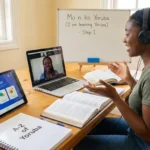
For Yorùbá-speaking diaspora families, structured online programmes built specifically for this audience are now accessible from anywhere. The Yorùbá Club for Kids runs live online sessions designed for diaspora children, taught by certified Yorùbá instructors. For children ready to read and write, the Yorùbá Reading School focuses on literacy. For families who prefer fully personalised instruction, Personalised Classes offer one-on-one sessions matched to your child’s level and schedule.
Consistency beats intensity. A 30-minute Yorùbá rhythm five days a week will outperform a heroic three-hour Saturday session every single time. Here is what a sustainable family routine looks like in practice.
Anchor Yorùbá to existing routines, not new ones. Greetings during morning prep. A Yorùbá song during the school commute. Five minutes of Yorùbá storytime at bedtime three nights a week. The new habits piggyback on what is already happening.
Reserve a one-hour slot for the structured online class — the same day, the same time, every week. Treat it like a piano lesson, not an optional activity. Predictability is what builds the routine.
If both parents are Yorùbá speakers, agree on the language rules together. If one parent does not speak Yorùbá, make sure they support the routine — even a non-Yorùbá-speaking parent can hold the line on “Yorùbá at the dinner table” if they understand why it matters. The routine does not survive without household alignment.
Six months of this is enough to change a child’s relationship with the language. A year of it produces a child who can hold real conversations. Two years produces a child who feels Yorùbá as theirs, not as something their parents impose on them. That is the goal.
As early as possible. Newborns benefit from being spoken to in Yorùbá even before they can respond. The structured learning window — formal classes, reading, writing — typically opens between ages four and six and stays optimal through early adolescence. Research suggests starting before age ten is ideal for native-like fluency, but meaningful learning continues through the teenage years.
No. This is called receptive bilingualism, and it is one of the most common patterns in diaspora children. The foundation — sounds, vocabulary recognition, intuitive grammar — is already there. With consistent structured practice, receptive understanding can be activated into speaking, often within months. The hardest part is breaking the English-default reflex, not the language itself.
Plan for at least one structured class per week (45–60 minutes) plus 15–30 minutes of daily home exposure. That is roughly four to six hours of Yorùbá contact per week, which is the minimum threshold most heritage language research associates with measurable progress in young children.
Then your job is not to teach — it is to support. Your role is to maintain the routine, model effort by trying alongside your child, and outsource the structured teaching to certified instructors. Many of the strongest heritage language outcomes come from households where parents are intermediate speakers but committed to the routine.
No. Constant correction silences children faster than almost anything else. Affirm the attempt first. Correct gently and selectively — focus on tones and meaning-changing errors, not on every imperfect word. The goal at this stage is confidence and continuity, not precision. Precision comes later, with structured instruction.
Yes — when the format is built for them. Live, interactive, age-appropriate online classes with small groups and trained instructors work very well for children. Recorded videos and unstructured app use do not. The difference is engagement, accountability, and feedback. A good online Yorùbá programme is structured around all three.
Teaching your child Yorùbá while living abroad is one of the most meaningful gifts you can give them. It is also one of the most sustainable when built on the right foundations.
The window is open. The structure exists. The only thing missing is the decision to begin.
| GIVE YOUR CHILD THEIR LANGUAGE Enrol your child in the Alámọ̀já Yorùbá Club for Kids — live online classes built for diaspora children, taught by certified Yorùbá instructors. For children ready to read and write Yorùbá, explore the Yorùbá Reading School. |
Share Post On:
Get the latest Yoruba learning resources delivered to your inbox